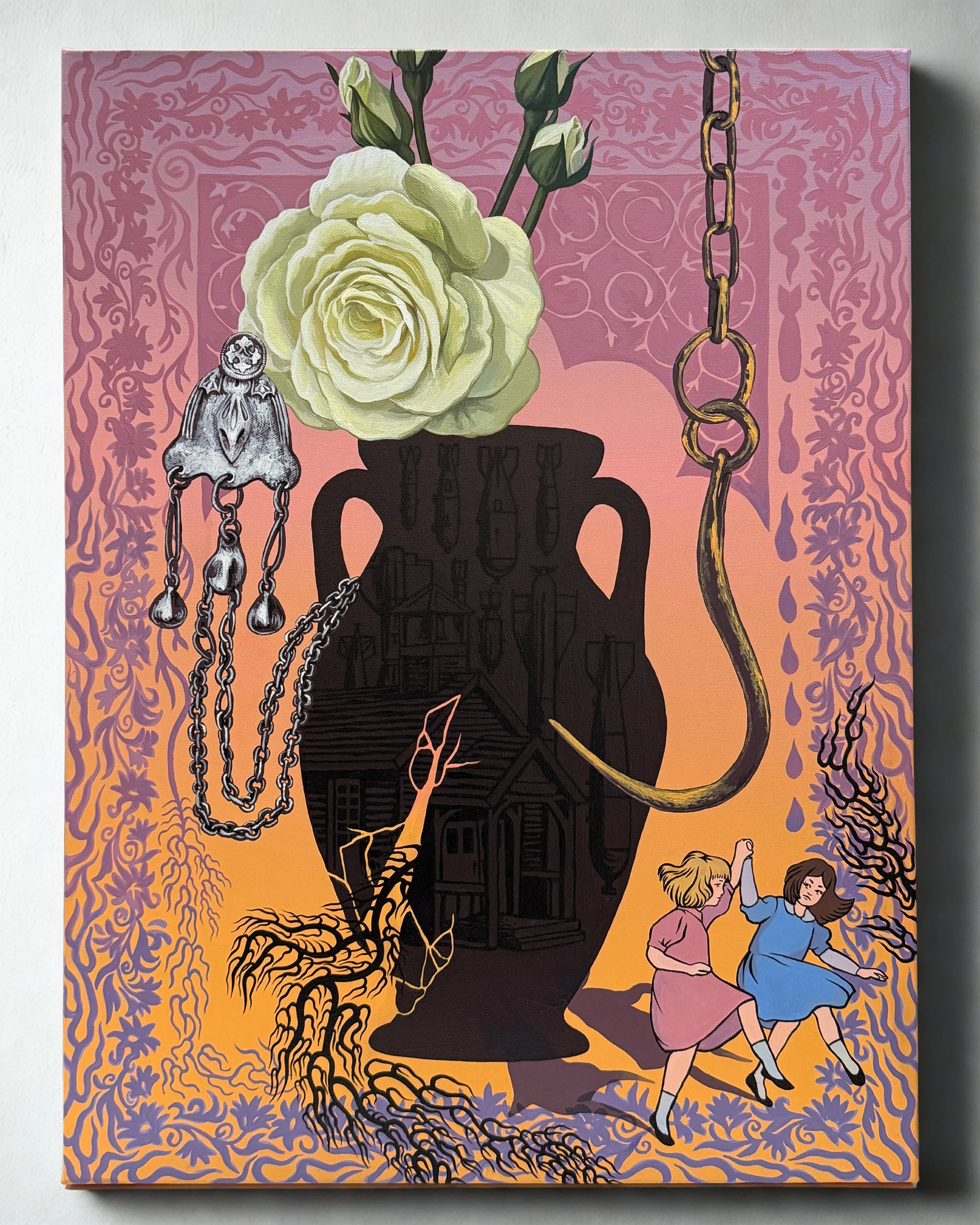
MOURNING POTS
This body of work began with a quote by Vincent van Gogh, who described himself as a "broken pot" during one of the most difficult periods of his life. But he reinterpreted his brokenness as a way to deepen his ability to create. The more fractured he became, the more intensely he felt compelled to make art. That idea became the inspiration for this series and for me to create my work.
I was drawn to this quote because I found myself overwhelmed by the constant stream of violence, injustice, and tragedy in the current state of the world. Through news and media, I am confronted with wars, terrorist attacks, hate crimes, mass shootings, sexual violence, political corruption, environmental destruction, and the silencing of vulnerable voices. As an artist whose practice often responds to these events soon after they occur, I started to feel as if I couldn’t keep up with the desistation, who resably could? My larger paintings require months to complete, yet new tragedies emerge daily. Before one work is finished, another story demands my attention.
Each painting in Broken Pots centers on a vessel that serves as a container for grief. Within these pots are stories of people and events shaped by conflict, injustice, displacement, violence, and loss. The vessels become symbolic repositories for collective wounds. Some contain references to specific events, while others hold broader concerns about humanity's capacity for both destruction and survival. Like people, these vessels bear the weight of what they carry.
Emerging from each pot are flowers that symbolize hope, resilience, and the possibility of renewal. They exist alongside imagery drawn from contemporary events and layered with references to folklore, children's stories, decorative arts, fairy tales, and cultural ornamentation. At first glance, these visual elements may appear playful, nostalgic, or familiar. I intentionally use them as points of entry. They invite viewers into the work before revealing the more difficult realities hidden beneath the surface. Much like the news itself, what initially appears distant or harmless often conceals profound suffering.
As an artist, I am interested in how people create meaning in the face of overwhelming loss. Yet this series also acknowledges the emotional toll of bearing witness. The constant act of responding to tragedy begins to leave its own marks. In many ways, these works are not only about the events they depict but also about the psychological weight of continually absorbing them. The vessels become stand-ins for both society and the self, carrying more and more until cracks begin to form.
I do not see these paintings as depictions of tragedy alone. They are records of endurance. The pots may be broken, but they remain capable of holding stories, memories, warnings, and hope. Their fractures do not render them useless; they reveal the burden of what they contain.
Broken Pots is ultimately a meditation on survival in an age of relentless information. It asks how individuals and societies continue to carry grief, how beauty persists alongside violence, and how we remain human while witnessing a world that often feels as though it is breaking apart.


